
PPSI Interop — The Federal-State Interoperability Standard for Payment Stablecoin Issuers
Intro The GENIUS Act creates four distinct licensing pathways for payment stablecoin issuers — federal and state, bank and nonbank. PPSI Interop addresses the most complex question that emerges from this architecture: when and how can a state-regulated issuer operate alongside, transition into, or satisfy the requirements of the federal framework?
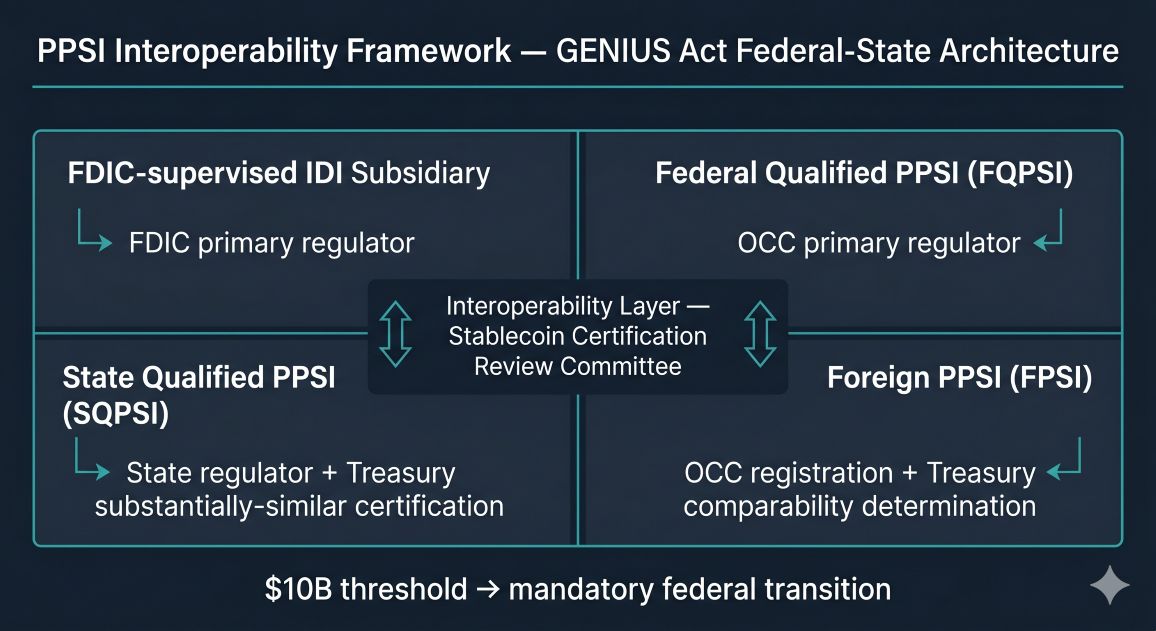
Pillar 1: Why PPSI Interoperability Is the Most Structurally Complex Requirement of the GENIUS Act
The GENIUS Act does not create a single licensing pathway — it creates four. The GENIUS Act creates three pathways to become a PPSI: a subsidiary of an insured depository institution approved by its primary federal regulator, a Federal Qualified Payment Stablecoin Issuer approved by the OCC, and a State Qualified Payment Stablecoin Issuer approved by a state regulator. Additionally, the GENIUS Act creates a path for foreign payment stablecoin issuers to continue circulating their stablecoins among US persons. Mayer Brown
Each pathway operates under a different primary regulator — yet all must achieve functional interoperability for the US payment stablecoin market to operate as a unified system. Three structural requirements define compliant PPSI interoperability:
Substantially Similar State Regimes: Under the GENIUS Act, a PPSI that is a State Qualified Payment Stablecoin Issuer may opt to be regulated under a state-level regulatory regime only if that regime is substantially similar to the federal regulatory framework and has obtained a unanimous determination by the Stablecoin Certification Review Committee that it meets or exceeds the standards in Section 4(a) of the GENIUS Act. Sullivan & Cromwell
The $10 Billion Transition Threshold: A PPSI that is initially regulated at the state level is required under the GENIUS Act to transition to federal regulation after issuing more than $10 billion in outstanding payment stablecoins, unless this requirement is waived. The PPSI must request the waiver within 240 days of crossing the threshold. Sullivan & Cromwell
Treasury Broad-Based Principles: On April 3, 2026, Treasury published a Notice of Proposed Rulemaking establishing broad-based principles for determining whether a state-level regulatory regime is substantially similar to the federal framework. Treasury expects that a state’s implementation will lead to regulatory outcomes that are at least as stringent and protective as the federal regulatory framework. Federal Register
Source: Treasury NPRM — GENIUS Act Broad-Based Principles for State Similarity, Federal Register, April 3, 2026
Pillar 2: The Interoperability Gap — Four Failure Modes Across the PPSI Licensing Architecture
The structural complexity of a four-pathway licensing framework creates predictable compliance gaps at every transition point — from state to federal, from nonbank to bank-affiliated, and from domestic to foreign issuer.
State Certification Gap: A state-regulated PPSI that cannot demonstrate its home regime meets Treasury’s substantially similar standard faces immediate market access restrictions. Without a continuously verified, machine-readable certification signal, counterparties cannot confirm that a state-issued stablecoin meets the same standards as a federally licensed one.
Threshold Transition Risk: State-qualified payment stablecoin issuers that exceed the statutory issuance threshold must transition to federal oversight. PPSIs approaching the $10 billion threshold without a transition framework in place face a regulatory cliff — issuance may need to halt while federal licensing is obtained. Gibson Dunn
Foreign Issuer Comparability Gap: For foreign PPSIs, the OCC evaluates whether the FPSI presents a risk to the financial stability of the United States, including risks relating to ensuring timely redemption for US customers, and whether the FPSI presents illicit finance risks. Without a real-time comparability status signal, institutional counterparties cannot verify foreign PPSI eligibility at the moment of settlement. Sullivan & Cromwell
Agentic Cross-Pathway Risk: In automated settlement environments, AI agents and smart contracts cannot distinguish between a federally licensed PPSI, a certified state PPSI, and a non-compliant issuer without a machine-readable, on-chain interoperability status signal. Every automated transaction involving a stablecoin issued under an unverified pathway carries unresolved legal exposure.
This is where PPSIInterop.com functions as the institutional cross-pathway compliance registry — continuously tracking licensing status, state certification, transition thresholds, and foreign comparability determinations. And where PPSIInterop.eth translates that registry into a blockchain-native interoperability signal, queryable at the exact moment of execution.
Pillar 3: PPSIInterop as the Licensing Layer of the PillarsX Compliance Stack
Every institutional counterparty engaging with a payment stablecoin needs one confirmed signal before settlement: which licensing pathway governs this issuer — and is that pathway currently compliant with the full GENIUS Act framework?
Within the PillarsX infrastructure, PPSIInterop.com/.eth functions as the licensing verification layer:
PPSIInterop.eth            →  Licensing pathway confirmed
        ↓                     [Settlement Authorization]
PPSISettlement.eth         →  Settlement clearance verified
        ↓                     [Reserve Compliance]
PermittedReserves.eth      →  Reserve composition validated
                              [Programmable Compliance]
→ For the complete PPSI settlement framework: PPSISettlement — Settlement Infrastructure Standard
Strategic Constellation & Bundle Potential
| Domain | Function | Regulatory Hook |
|---|---|---|
| PPSIInterop.com/.eth | Cross-pathway licensing registry & state certification monitor | Treasury NPRM April 2026 — Substantially Similar Standard |
| PPSISettlement.com/.eth | Settlement clearance across all PPSI pathways | GENIUS Act § 3 – Permitted Issuers Only |
| SQPSi.com/.eth | State Qualified PPSI status & certification tracker | GENIUS Act § 4 – SQPSI Certification |
| CoveredCustodian.com/.eth | Custodian qualification across all PPSI types | GENIUS Act § 10(a) – Covered Custodian |
All content is for informational purposes only and does not constitute financial advice.