
stablecoinintent.com & .eth | Stablecoin Intent Verification Identity
🔴 Regulatory Update — June 10, 2026
Mastercard Agent Pay for Machines confirms stablecoin intent verification as live operational requirement — Ripple RLUSD executes AI agent payments with enforced compliance rules and full audit trails
Mastercard launched Agent Pay for Machines on June 10, 2026 with Ripple/XRPL and RLUSD as confirmed infrastructure partners — enabling AI agents to move stablecoin value within enforced rules at machine speed. Every RLUSD transaction in the Agent Pay ecosystem is a stablecoin intent event: an AI-initiated payment that must satisfy GENIUS Act BSA requirements, OCC settlement standards, and FinCEN AML monitoring simultaneously at the moment of execution. With OCC Final Rules due July 18, 2026, every PPSI deploying AI agent payment infrastructure must document its stablecoin intent verification standard before the deadline.
→ Source: Mastercard — Agent Pay for Machines, June 10, 2026🔴 Regulatory Update — June 10, 2026
Mastercard launches Agent Pay for Machines — AI agents transacting at machine speed require verified intent infrastructure with controls, smart contracts, and guaranteed settlement
Mastercard launched Agent Pay for Machines on June 10, 2026 — enabling AI agents to transact autonomously at machine speed with enforced controls, smart contract execution, and guaranteed settlement including micro-transactions. Ripple/XRPL and RLUSD are confirmed infrastructure partners enabling fast, programmable, compliant settlements. Markus Infanger of RippleX confirmed: XRPL and RLUSD let agents move value within enforced rules with full audit trails. Every AI agent transacting on behalf of an institution requires verified intent documentation — confirming that the transaction is authorized, compliant, and traceable under GENIUS Act BSA requirements before July 18, 2026.
→ Source: Mastercard — Agent Pay for Machines, June 10, 2026On June 10, 2026, Mastercard launched Agent Pay for Machines — enabling AI agents to transact autonomously at machine speed with enforced controls, smart contracts, and guaranteed settlement. Ripple confirmed XRPL and RLUSD as the Web3 infrastructure layer: agents move value within enforced rules with full audit trails. The Two-Rail architecture is now live at institutional scale: Mastercard’s Web2 compliance framework on one rail, XRPL’s Web3 execution layer on the other.
This architecture creates a precise verification requirement. When an AI agent initiates a stablecoin transaction — a PPSI redemption, a micro-payment, a collateral movement — it must demonstrate verified intent: that the transaction is authorized by a legitimate principal, compliant with AML/CFT requirements, and traceable under regulatory examination standards. Speed alone is not sufficient. Mastercard’s own launch language confirms this: payments need more than speed — they need trust, controls, and clear rules for how value moves.
The GENIUS Act makes this concrete: every PPSI is treated as a financial institution for Bank Secrecy Act purposes, meaning every stablecoin transaction — including AI agent-initiated redemptions — must satisfy FinCEN AML monitoring requirements at the moment of execution. Intent verification is not optional compliance overhead — it is the statutory foundation of every PPSI transaction under federal law.
stablecoinintent.com is the institutional Web2 portal identity for stablecoin intent verification — the legal brand that appears in GENIUS Act compliance documentation, AI agent authorization frameworks, and institutional stablecoin transaction contracts wherever verified intent must be documented under banking law. stablecoinintent.eth is the programmable on-chain routing identity — the ENS endpoint that software architects embed directly into stablecoin transaction protocol logic to route intent verification to atomic compliance confirmation without intermediary DNS dependency.
Together they form the complete Convergence Identity for the stablecoin intent verification standard that every PPSI, every AI agent payment platform, and every institution deploying programmable stablecoin infrastructure must establish.
Namespace Acquisition: This Twin-Domain asset is available for institutional acquisition. Inquiries: hq@pillarsx.com
The Regulatory Foundation of Stablecoin Intent Verification
The GENIUS Act defines a payment stablecoin as a digital asset whose issuer is obligated to convert, redeem, or repurchase for a fixed amount of monetary value — at par, on demand, within two business days. This redemption obligation is intent-governed: the statutory trigger is a customer submitting a redemption request — a verified expression of intent that the issuer must process within the two-business-day window under OCC examination standards. The PPSI settlement infrastructure documenting this redemption execution is anchored at ppsisettlement.com.
The FinCEN/OFAC PPSI AML NPRM — comment period closed June 9, 2026 — defines the BSA compliance obligations that apply to every stablecoin transaction: every redemption, every issuance, every reserve movement must satisfy AML monitoring requirements at the moment of execution. Intent verification is the mechanism through which this simultaneous compliance is achieved — the documented proof that a transaction originated from an authorized principal acting within permitted parameters. The AML intent verification standard for this compliance layer is anchored at amlintent.com & .eth.
Mastercard’s Agent Pay for Machines launch on June 10, 2026 confirms that intent verification has moved from regulatory requirement to operational infrastructure standard. When AI agents transact autonomously at machine speed, the enforced controls and audit trails that Mastercard and Ripple describe are intent verification in practice — the documented chain from authorized principal through compliant execution to immutable settlement record. The generalized intent verification framework connecting stablecoin intent to the broader verifiable intent namespace is anchored at verifiableintent.com & .eth.
How Stablecoin Intent Verification Architecture Works
Stablecoin intent verification infrastructure operates through three simultaneous layers that stablecoinintent.com documents and stablecoinintent.eth routes through.
The authorization layer captures and verifies the intent of every stablecoin transaction before execution — confirming that the initiating principal is an authorized entity, that the transaction parameters are within permitted limits, and that the intent is documented in a format that satisfies OCC examination standards and FinCEN AML monitoring requirements simultaneously. For AI agent transactions this layer is the critical compliance checkpoint — the moment where machine-speed execution meets regulatory accountability. The PPSI gateway routing authorized transactions through Federal Reserve payment infrastructure is documented at ppsigateway.com & .eth.
The compliance documentation layer generates immutable records of every verified intent event — the authorization chain, the compliance check results, the execution parameters, and the settlement confirmation — in a format accessible to OCC examiners, FDIC BSA compliance officers, and FinCEN AML monitors simultaneously. The GENIUS Act’s BSA treatment of PPSIs requires that this documentation be available for regulatory examination at any point — making the intent verification record as legally significant as the settlement record itself. The permitted reserves standard ensuring 1:1 backing throughout every intent-verified settlement cycle is documented at permittedreserves.com & .eth.
The on-chain attestation layer records verified intent confirmations directly on the blockchain — creating an immutable, tamper-proof audit trail that satisfies both Web2 regulatory examination standards and Web3 protocol verification requirements simultaneously. Ripple confirmed on June 10, 2026 that XRPL and RLUSD enable agents to move value within enforced rules with full audit trails — the on-chain attestation layer is the infrastructure through which these audit trails achieve legal finality. stablecoinintent.eth is the W3C DID-compliant ENS endpoint for this three-layer architecture — the on-chain routing identity that software architects embed directly into stablecoin transaction protocol logic.
The Stablecoin Intent Verification Ecosystem
stablecoinintent is the PPSI-specific intent verification core of the PillarsX intent namespace. It connects directly to verifiableintent.com & .eth as the generalized intent verification identity of which stablecoin intent is the most immediate regulatory implementation, and to amlintent.com & .eth as the AML-specific intent verification standard that governs the compliance layer of every stablecoin transaction.
Beyond the intent cluster, stablecoinintent integrates with ppsisettlement.com as the PPSI settlement identity whose every redemption transaction requires verified intent documentation, ppsigateway.com & .eth as the payment gateway routing intent-verified PPSI transactions through Federal Reserve infrastructure, and qdacverify.com & .eth as the QDAC verification standard confirming digital asset classification before intent-verified settlement execution.
The complete stablecoin intent verification stack — stablecoinintent for intent documentation, verifiableintent for generalized framework, amlintent for BSA compliance layer — provides every PPSI and AI agent payment platform with a complete intent namespace that covers legal documentation, on-chain attestation, and regulatory examination simultaneously.
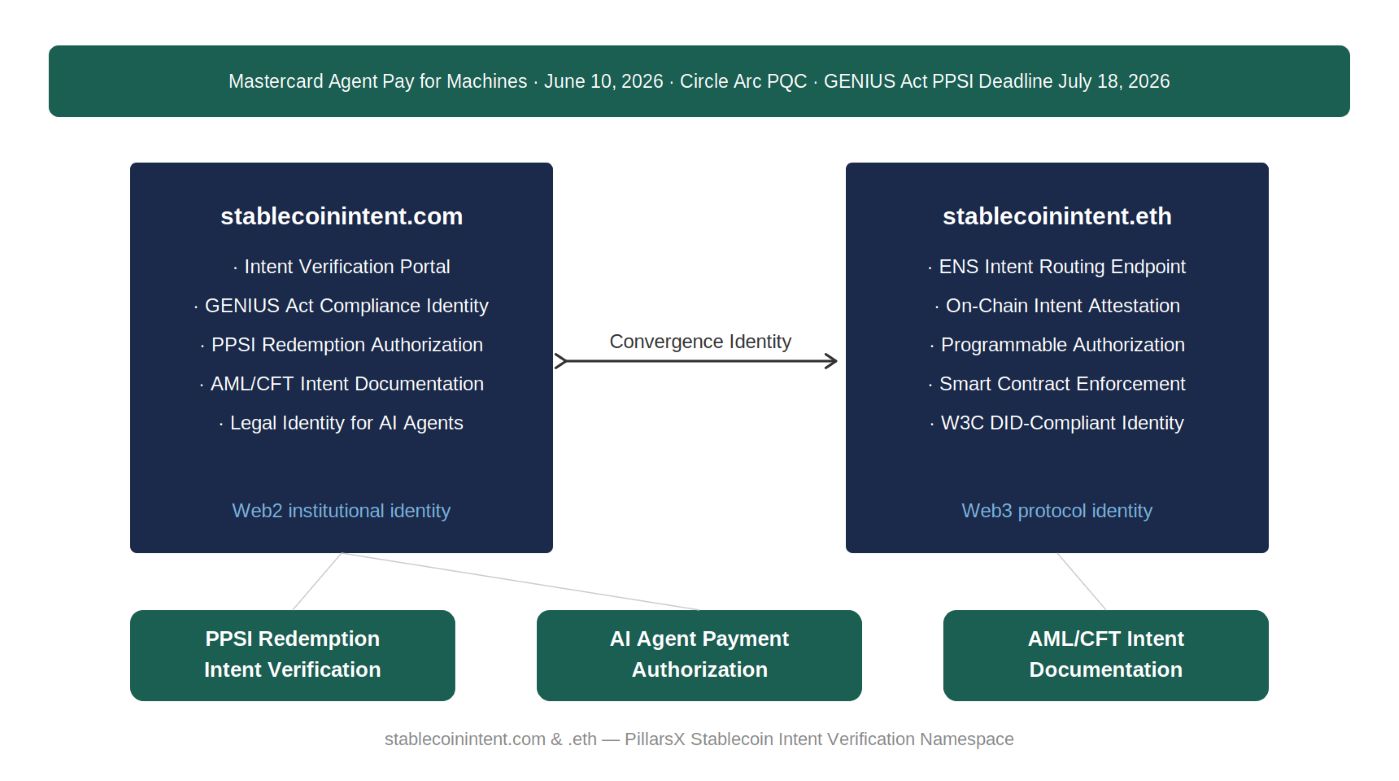
The Stablecoin Intent Verification Ecosystem
stablecoinintent is the PPSI-specific intent verification core of the PillarsX intent namespace. It connects directly to verifiableintent.com & .eth as the generalized intent verification identity of which stablecoin intent is the most immediate regulatory implementation, and to amlintent.com & .eth as the AML-specific intent verification standard that governs the compliance layer of every stablecoin transaction.
Beyond the intent cluster, stablecoinintent integrates with ppsisettlement.com as the PPSI settlement identity whose every redemption transaction requires verified intent documentation, ppsigateway.com & .eth as the payment gateway routing intent-verified PPSI transactions through Federal Reserve infrastructure, and qdacverify.com & .eth as the QDAC verification standard confirming digital asset classification before intent-verified settlement execution.
The complete stablecoin intent verification stack — stablecoinintent for intent documentation, verifiableintent for generalized framework, amlintent for BSA compliance layer — provides every PPSI and AI agent payment platform with a complete intent namespace that covers legal documentation, on-chain attestation, and regulatory examination simultaneously.
Related Infrastructure Series
STRATEGIC CONSTELLATIONS & BUNDLE POTENTIAL
Bundle 1 — “The Stablecoin Intent Core” (for PPSI Operators and AI Agent Payment Platforms) Target: Circle, Paxos, Ripple RLUSD, PayPal PYUSD — all PPSIs building GENIUS Act-compliant intent verification infrastructure before July 18, 2026. Domains: stablecoinintent.com/.eth + verifiableintent.com/.eth + amlintent.com/.eth. Complete intent verification namespace — stablecoin-specific identity, generalized framework, and AML compliance layer.
Bundle 2 — “The Agent Pay Compliance Stack” (for AI Agent Payment Infrastructure Providers) Target: Mastercard Agent Pay partners, Ripple/XRPL ecosystem, OpenAI/Anthropic payment agent platforms. Domains: stablecoinintent.com/.eth + verifiableintent.com/.eth + ppsigateway.com/.eth. Complete AI agent payment compliance namespace — intent verification, generalized framework, and Fed gateway routing.
Bundle 3 — “The Full PPSI Intent Infrastructure” (for Strategic Acquirers) Domains: stablecoinintent.com/.eth + verifiableintent.com/.eth + amlintent.com/.eth + ppsisettlement.com + qdacverify.com/.eth. The complete PillarsX stablecoin intent namespace — every layer from intent verification through AML compliance to PPSI settlement execution. This package exists exactly once.
📄 Academic Foundation
Twin-Domain Convergence Identity — The Institutional Framework Behind This Namespace
This Twin-Domain asset is part of the namespace architecture formalized in "Twin-Domain Convergence Identity: A Framework for Institutional Namespace Standards in Regulated Digital Asset Infrastructure" by Rolf Neumayr, PillarsX (SSRN Working Paper, 16 pages, posted June 12, 2026), classified under Monetary Economics — International Financial Flows, Financial Crises, Regulation & Supervision.
→ Read the Paper on SSRNRegulatory Sources
- Mastercard — Agent Pay for Machines Launch, June 10, 2026
- RippleX — XRPL and RLUSD as Agent Pay Infrastructure, June 10, 2026
- Federal Register — FinCEN/OFAC PPSI AML/Sanctions NPRM, April 10, 2026
- OCC GENIUS Act NPRM — Federal Register, March 2, 2026
- GENIUS Act — BSA Treatment of PPSIs as Financial Institutions, July 2025
- Circle — Arc Post-Quantum Cryptography Infrastructure, June 2026
Explore Related PillarsX Infrastructure
- verifiableintent.com & .eth — Verifiable Intent Identity
- amlintent.com & .eth — AML Intent Identity
- ppsisettlement.com — PPSI Settlement Identity
- ppsigateway.com & .eth — PPSI Gateway Identity
- qdacverify.com & .eth — QDAC Verification Identity
- permittedreserves.com & .eth — Permitted Reserves Identity
- ppsiledger.com & .eth — PPSI Ledger Identity
- pqcintent.com & .eth — Post-Quantum Intent Identity
Strategic Acquisition Inquiry
Initiate secure communication with representatives of the IP holder to evaluate the acquisition of this premium infrastructure namespace or its corresponding strategic asset bundle.