
verificationcontrol.com | Verification Control Identity
🔴 Regulatory Update — June 1, 2026
CLARITY Act on Senate Calendar — verification control obligations for distributed ledger application layers enter final legislative phase
The Digital Asset Market Clarity Act was placed on the US Senate Legislative Calendar on June 1, 2026 — establishing verification control standards for distributed ledger application layers as permanent federal statutory requirements. Section 302 codifies pre-trade compliance verification obligations. Galaxy Digital placed a $10 million institutional prediction market bet on CLARITY Act passage in 2026. August 3 remains the realistic presidential signing target.
→ Source: CoinPedia — CLARITY Act Senate Calendar, June 2, 2026🔴 Regulatory Update — May 22, 2026
FDIC BSA rule establishes verification control as mandatory PPSI compliance standard
The FDIC proposed rule shifts stablecoin compliance from retrospective enforcement to proactive verification — requiring PPSIs to build systems that verify transaction compliance before settlement, making on-chain verification control the definitive federal standard for BSA and sanctions compliance documentation.
→ Source: FDIC.gov, May 22, 2026🔴 Regulatory Update — May 11, 2026
Grassley-Lummis deal establishes demonstrable culpability as the federal verification standard
The Grassley-Lummis AML compromise established that AML prosecution applies only to demonstrably culpable actors — making cryptographic on-chain verification control the definitive compliance mechanism that separates protected infrastructure operators from prosecutable illicit finance facilitators under the CLARITY Act.
→ Source: CoinDesk, May 14, 2026In 2026, institutional on-chain compliance verification has evolved from reactive monitoring into automated, pre-trade infrastructural enforcement — and the cost of getting it wrong has never been higher.
Celsius Network claimed full reserve backing for $3 billion in customer assets. Without cryptographic verification control, that claim was unverifiable until the collapse. FTX processed billions in customer funds without a single on-chain verification layer that regulators, counterparties, or clients could independently audit.
The Grassley-Lummis AML compromise of May 11, 2026 draws the definitive legal boundary: institutions that can produce cryptographic proof of compliant intent are protected. Those that cannot are demonstrably culpable. This is not a future compliance requirement — it is the current federal standard advancing toward law.
verificationcontrol.com is the Convergence Identity for the institutional infrastructure that produces this proof — the namespace at the intersection of CLARITY Act verification standards, GENIUS Act reserve attestation requirements, and the emerging global standard for pre-trade compliance enforcement.
verificationcontrol.com is the institutional Web2 portal identity for the infrastructure that produces this proof — the legal brand that appears in CLARITY Act Section 302 compliance submissions, GENIUS Act reserve attestation documentation, and institutional pre-trade enforcement agreements wherever cryptographic verification control must be referenced. verificationcontrol.eth is the programmable on-chain routing identity — the ENS endpoint that software architects embed directly into pre-trade compliance protocol logic to execute verification control before every regulated transaction, without intermediary DNS dependency.
Together they form the complete Convergence Identity for the verification control standard that every institution building CLARITY Act-compliant pre-trade enforcement infrastructure must implement before the August 3 presidential signing target.
Why CLARITY Act Section 302 Makes Pre-Trade Verification Control a Federal Compliance Requirement
The structural failure of legacy compliance systems is not a technology problem — it is a verification architecture problem. Driven by frameworks like MiCAR and the FATF Travel Rule, the industry has shifted toward ex-ante smart contract protocols that verify real-world identities and restrict bad actors before transactions execute rather than after they settle.
The Grassley-Lummis AML Compromise (May 11, 2026) established the demonstrable culpability standard as the federal threshold for AML prosecution — making verification control the legal boundary between protected infrastructure and prosecutable illicit finance.
The Digital Asset Market Clarity Act Section 2 defines Related Persons and Ancillary Asset Originators with precise disclosure obligations — all of which require cryptographic verification of compliance status before any transaction can be executed compliantly.
The Morrison Foerster GENIUS Act Analysis (May 7, 2026) confirmed that PPSIs must maintain technical capabilities to block, freeze, and reject transactions — capabilities that are only regulatorily meaningful if they are accompanied by cryptographic verification records that prove the decision was made in good faith under a legitimate compliance program.
The Shanaka Anslem Perera “Verification Collapse” analysis (May 2026) identified the core structural vulnerability of the current financial system: production costs have fallen faster than verification costs — creating a systemic gap that only cryptographic verification control infrastructure can close. Together these four regulatory and analytical events define the on-chain compliance verification standard that verificationcontrol.com holds the namespace for.
The Convergence Identity: How verificationcontrol.com Produces Cryptographic Proof of Compliant Intent
Every institution building on-chain compliance infrastructure faces the same verification challenge: how does it demonstrate to regulators, counterparties, and auditors that its compliance decisions — every block, every freeze, every transaction approval — were made under a verifiable, cryptographically documented compliance program rather than arbitrary or discretionary judgment?
verificationcontrol.com is the institutional answer — the compliance portal, the verification governance brand, and the legal identity for any institution that must produce cryptographic proof of compliance control under the CLARITY Act and GENIUS Act frameworks.
It is not merely a domain name — it is the namespace that signals institutional awareness of the verification gap that collapsed Celsius and FTX, and the architectural commitment to closing that gap through pre-trade compliance enforcement.
verificationcontrol.com provides the institutional Web2 portal identity — the legal brand that compliance teams reference in CLARITY Act Section 302 submissions, GENIUS Act reserve attestation documentation, and institutional pre-trade enforcement agreements.
verificationcontrol.eth is the programmable on-chain routing identity — the ENS endpoint that software architects embed directly into pre-trade compliance protocol logic to execute verification control before every regulated transaction. Where the Grassley-Lummis standard defines what demonstrable culpability means legally, verificationcontrol.eth provides the machine-readable routing layer that protocol engineers embed into compliance infrastructure to produce the cryptographic proof that the standard requires — connecting legal compliance governance to on-chain verification execution in a single ENS endpoint.
Together, verificationcontrol.com & .eth form the complete Convergence Identity: the legal anchor for compliance teams documenting pre-trade verification control under CLARITY Act and GENIUS Act standards, and the technical routing layer for software architects implementing cryptographic proof-of-control — the two audiences that every institutional verification control deployment must simultaneously satisfy.
The Verification Control Ecosystem: From Pre-Trade Enforcement to On-Chain Attestation
verificationcontrol is the governance apex of the PillarsX compliance verification namespace. It connects directly to amlintent.com/.eth — the AML intent documentation standard that produces the evidence verificationcontrol governs — and to programmablecompliance.com/.eth as the automated enforcement layer that executes compliance decisions under verificationcontrol’s governance framework.
Beyond the compliance cluster, verificationcontrol integrates with dvpverify.com/.eth as the DVP settlement verification standard, fheverify.com as the FHE privacy-preserving verification layer that enables confidential compliance attestations, and dtaverify.com as the Digital Transfer Agent verification identity for registered securities.
The verification architecture that institutions need in 2026 is not a single product — it is a layered infrastructure stack where every settlement, every custody operation, and every compliance decision generates a cryptographic proof that is stored, auditable, and legally defensible. verificationcontrol is the governance identity for this stack.
verificationcontrol.com & .eth is the governance identity for the complete PillarsX verification stack — the namespace that connects pre-trade AML documentation, programmable compliance enforcement, DVP settlement verification, FHE privacy-preserving attestation, and Digital Transfer Agent verification into a single institutional compliance governance architecture.
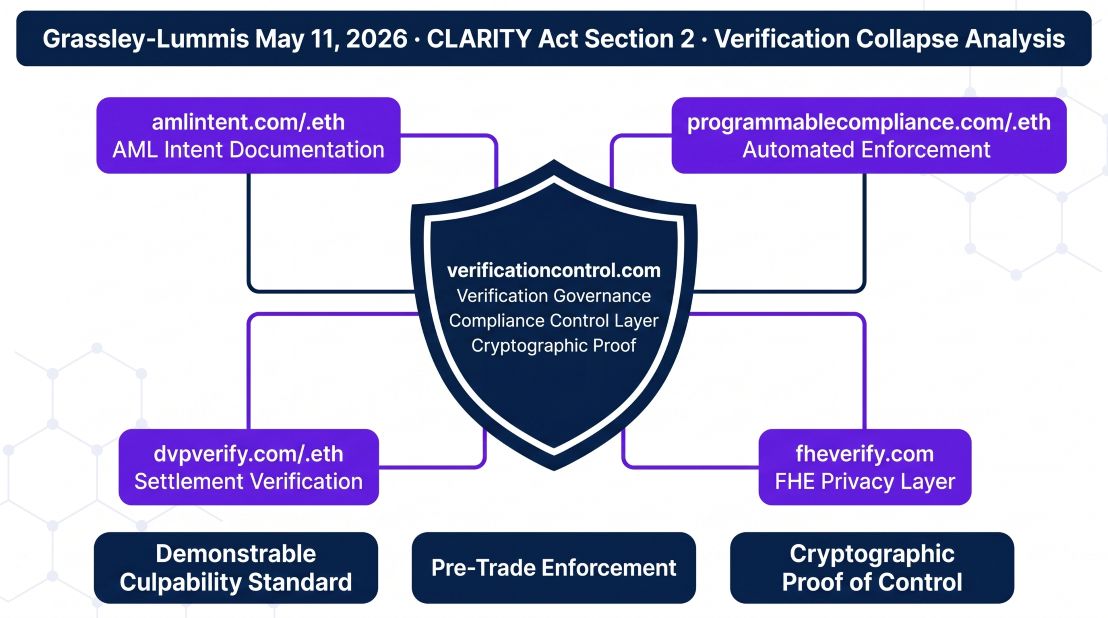
Strategic Constellations & Bundle Potential
Bundle 1 — “The CLARITY Act Verification Stack” (for Digital Asset Operators) Target: Every crypto exchange, stablecoin issuer, and DeFi protocol subject to CLARITY Act verification requirements. Domains: verificationcontrol.com + amlintent.com/.eth + programmablecompliance.com/.eth. Complete verification governance namespace — control identity, intent documentation, and automated enforcement in one acquisition.
Bundle 2 — “The Privacy Verification Stack” (for FHE & Confidential Computing Infrastructure) Target: Institutions requiring confidential compliance verification. Domains: verificationcontrol.com + fheverify.com/.eth + dvpverify.com/.eth. Complete privacy verification namespace — governance identity, FHE verification layer, and DVP settlement verification standard.
Bundle 3 — “The Full Compliance Infrastructure” (for Strategic Acquirers) Domains: verificationcontrol.com + amlintent.com/.eth + programmablecompliance.com/.eth + relatedperson.com/.eth + ancillaryoriginator.com/.eth. The complete PillarsX CLARITY Act compliance namespace — verification governance, AML intent, programmable enforcement, insider compliance, and originator standard. This package exists exactly once.
Related PillarsX Infrastructure
programmablecompliance.com & .eth — the automated enforcement layer executing compliance decisions under verificationcontrol governance
amlintent.com & .eth — the AML intent documentation standard producing the evidence verificationcontrol governs
Regulatory Sources
Digital Asset Market Clarity Act Section 302 — Verification Control Obligations, 2026
Morrison Foerster — GENIUS Act AML Sanctions Analysis, May 7, 2026
CLARITY Act Senate Calendar Placement — June 1, 2026
Explore related PillarsX infrastructure
→ amlintent.com & .eth — AML Intent Documentation Identity
→ programmablecompliance.com & .eth — Programmable Compliance Identity
→ dvpverify.com & .eth — DVP Settlement Verification Identity
→ fheverify.com — FHE Privacy-Preserving Verification Identity
→ dtaverify.com & .eth — Digital Transfer Agent Verification Identity
→ intentverify.eth — Protocol Layer Intent Verification Identity
Strategic Acquisition Inquiry
Initiate secure communication with representatives of the IP holder to evaluate the acquisition of this premium infrastructure namespace or its corresponding strategic asset bundle.