
mcicustody.com & .eth | MCI Custody Identity
MiCA's full enforcement from 1 July 2026 subjects custodians and wallet providers to strict rules on client asset protection, asset segregation, and third-party custodian oversight — including clear disclosure when custody functions are outsourced. Custodians must undergo regular audits verifying proper segregation and security of customer assets, with ongoing own-funds requirements tied to fixed overheads. The OCC charter wave — covering Circle, Ripple, BitGo, Paxos, Fidelity Digital Assets, Coinbase, and others — creates the federally regulated custody infrastructure that institutional tokenization requires under GENIUS Act standards. The mcicustody namespace anchors institutional identity for MCI custody infrastructure operating under simultaneous MiCA segregation mandates and GENIUS Act qualified custody standards.
🔴 Regulatory Update — June 9, 2026
New York DFS proposes single-custodian concentration limit for stablecoin reserve assets — custody diversification becomes a formal state-level requirement alongside federal GENIUS Act alignment
The New York State Department of Financial Services announced proposed regulations on June 9, 2026 aligning its dollar stablecoin issuance framework with the federal GENIUS Act — retaining DFS's existing reserve and redeemability requirements while adding new provisions including a maximum limit on reserve assets held by a single custodian, a mandatory risk management plan covering internal controls and information security, an internal audit system, and rules governing transactions with insiders and related parties. For MCI custody arrangements specifically, the single-custodian concentration limit represents a concrete operational constraint: institutions can no longer satisfy reserve custody requirements by concentrating holdings with one provider, regardless of that provider's regulatory standing. The proposed rules entered a 10-day pre-proposal comment period beginning June 9, followed by a 60-day comment period after Federal Register publication. mcicustody.com & .eth anchors the namespace for this multi-custodian compliance standard.
→ Source: New York DFS — Proposed Stablecoin Regulations Aligning with GENIUS Act, June 9, 2026🔴 Regulatory Update — 2026
Circle and Paxos both pursue federal National Trust Bank Charters — MCI custody infrastructure moves toward a unified federal standard instead of a state-by-state patchwork
Circle, issuer of the $78 billion USDC stablecoin, and Paxos, which has operated under a New York state charter since 2015 and issues the $3.8 billion PYUSD stablecoin, are both pursuing federal national trust bank charters. Circle stated the charter would enhance regulatory oversight of its reserves while enabling institutional custody services; Paxos stated the federal platform would allow businesses to issue, custody, trade, and settle digital assets with greater clarity. National trust bank charters do not permit deposit-taking, checking, savings accounts, or FDIC insurance — but they do permit fiduciary activities including custody, settlement, payments, and asset management. For Multifunction Cryptoasset Intermediaries holding customer assets across multiple state jurisdictions today, this signals a structural shift toward a single federal custody standard rather than maintaining separate state-level charters and compliance regimes. mcicustody.com & .eth anchors the institutional namespace for this consolidating custody standard.
→ Source: SEC Crypto Custody Guidance, National Trust Bank Charters, 2026mcicustody is the qualified custody identity built for the regulatory moment the BIS and FDIC simultaneously defined in April 2026. The BIS FSI Occasional Paper No. 27 identified the absence of deposit insurance and inadequate custody safeguards as core vulnerabilities of Multifunction Cryptoasset Intermediaries — institutions that accept customer assets without the prudential protections that apply to traditional custodians.
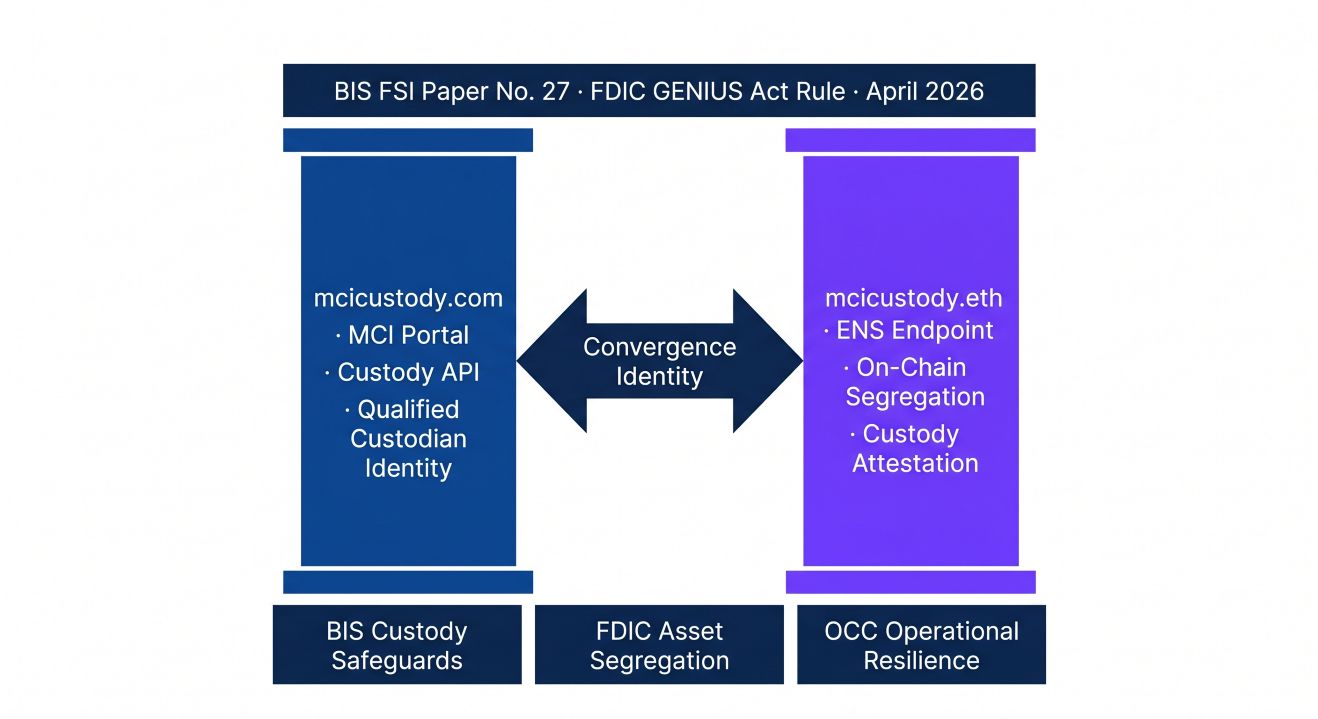
The FDIC Proposed Rule implementing the GENIUS Act simultaneously established explicit qualified custody requirements for all Permitted Payment Stablecoin Issuers. mcicustody.com & .eth is the Convergence Identity that addresses both frameworks directly: the institutional namespace for MCI-compliant qualified custody infrastructure, and a core component of the Multifunction Cryptoasset Intermediary domain stack. As the authoritative Multifunction Cryptoasset Intermediary custody identity, mcicustody.com & .eth sets the institutional standard for how regulated intermediaries brand and document their qualified custody frameworks under the emerging global MCI regulatory architecture.
Namespace Acquisition: This Twin-Domain asset is available for institutional acquisition. Inquiries: hq@pillarsx.com
The Qualified Custody Regulatory Mandate — BIS, FDIC, and CLARITY Act Converge
The BIS FSI Occasional Paper No. 27 identifies custody arrangements as a central vulnerability of MCIs — institutions that hold customer assets without the segregation, third-party oversight, and insurance mechanisms that apply to regulated custodians. The paper explicitly notes that MCI customers who transfer ownership of their assets through earn programmes become unsecured creditors of the platform — exposed to platform liquidity without deposit insurance or central bank backstop.
The failures of Celsius Network and FTX demonstrate precisely what happens when custody safeguards are absent. The FDIC Proposed Rule establishes strict qualified custody requirements for PPSI reserve assets — segregation of assets, third-party risk management, and cybersecurity frameworks. The OCC Proposed Rule requires institutions to demonstrate Operational Resilience across all custody operations. The CLARITY Act simultaneously establishes the Qualified Digital Asset Custodian as a statutory category — making qualified custody a dual-framework requirement under both GENIUS Act and CLARITY Act simultaneously. The QDAC verification standard for this statutory category is documented at qdacverify.com & .eth.
How MCI Custody Infrastructure Works Without Prudential Safeguards — And What mcicustody Fixes
Every Multifunction Cryptoasset Intermediary building qualified custody infrastructure under the BIS and FDIC frameworks faces the same institutional challenge: under what name does it present its custody capability to regulators, counterparties, and clients — and does it own that identity both on the classical web and on-chain?
mcicustody.com is the institutional answer — the compliance portal, the legal brand, and the API endpoint that signals BIS-aware qualified custody capability in a single memorable name. mcicustody.eth is the on-chain complement — an ENS-resolvable endpoint for custody attestations, segregation records, and qualified custodian verification stored as immutable distributed ledger entries. Under the GENIUS Act, PPSIs must apply bank-equivalent custody standards to all reserve assets — the MCI custody layer is the infrastructure that documents and demonstrates compliance with this requirement.
The BIS paper identifies Binance, Bybit, Coinbase, Crypto.com, MEXC and OKX as MCI examples — each of these institutions requires a custody namespace that meets the prudential standard the BIS now demands. Anchorage Digital — the first federally chartered digital asset bank — and BitGo — custodying $64 billion in digital assets — both operate under the qualified custody standard that mcicustody documents. The OCC covered custodian standard governing qualified custody under federal banking law is documented at coveredcustodian.com & .eth. The MCI ledger infrastructure storing custody records as immutable entries is documented at mciledger.com & .eth.
The MCI Custody Ecosystem — From Asset Protection to Settlement Execution
mcicustody is the asset protection core of the MCI namespace. It connects directly to mcisettle.com & .eth — every settled transaction requires custodied assets as the underlying collateral — and to mcirisk.com & .eth as the risk management layer that governs custody operations.
Beyond the MCI cluster, mcicustody integrates with coveredcustodian.com & .eth as the OCC qualified custody standard under federal banking law, qdacverify.com & .eth as the CLARITY Act Qualified Digital Asset Custodian verification standard, fhetrust.com & .eth as the FHE privacy-preserving custody layer, and agenticcollateral.com & .eth as the agentic collateral management standard that operates above the custody layer. The stablecoin intent verification confirming authorized custody transactions under GENIUS Act BSA requirements is documented at stablecoinintent.com & .eth.
An institution acquiring mcicustody.com & .eth secures the namespace for the most legally critical layer of MCI infrastructure — the one that determines whether customer assets are protected or exposed when platform liquidity fails.
Strategic Constellations & Bundle Potential
Bundle 1 — “The MCI Custody & Risk Stack” (for Qualified Custodians) Target: Anchorage Digital, BitGo, Fireblocks — institutional custody providers directly serving MCI clients. Domains: mcicustody.com/.eth + mcirisk.com/.eth + coveredcustodian.com/.eth. Complete MCI custody namespace — qualified custody identity, risk management layer, and OCC covered custodian standard in one acquisition.
Bundle 2 — “The MCI Asset Protection Stack” (for Banks Building MCI Infrastructure) Target: JPMorgan, Goldman Sachs, BNY Mellon — Tier-1 banks building digital asset custody services for MCI clients. Domains: mcicustody.com/.eth + mcisettle.com/.eth + fhetrust.com/.eth. Custody identity, settlement layer, and FHE privacy-preserving trust infrastructure — front-to-back asset protection namespace.
Bundle 3 — “The Full MCI Infrastructure” (for Strategic Acquirers) Domains: mcicustody.com/.eth + mcisettle.com/.eth + mcisettlement.com/.eth + mcirisk.com/.eth + mciledger.com/.eth. The complete PillarsX MCI stack — one acquirer secures the entire Multifunction Cryptoasset Intermediary namespace under the BIS and FDIC frameworks. This package exists exactly once.
Related Infrastructure Series
„All content is for informational purposes only and does not constitute financial advice.“