
rlnsettle.com & .eth | RLN Settlement Identity
🔴 Regulatory Update — June 9, 2026
FinCEN/OFAC PPSI AML/Sanctions NPRM comment period closes — RLN settlement infrastructure must satisfy BSA transaction monitoring at every interbank settlement node
The FinCEN and OFAC joint NPRM of April 8, 2026 implements AML and sanctions compliance requirements for all permitted payment stablecoin issuers under the GENIUS Act. Every RLN settlement transaction — including interbank deposit transfers, reserve movements, and wholesale CBDC exchanges — must satisfy BSA monitoring requirements simultaneously with settlement execution. The comment period closed June 9, 2026, marking the final step before binding AML rules apply to all PPSI settlement infrastructure by July 18, 2026.
→ Source: Federal Register — FinCEN/OFAC PPSI AML NPRM, April 10, 2026🔴 Regulatory Update — May 27, 2026
BIS Project Agorá confirms RLN architecture as the multi-bank settlement layer for tokenized deposit coordination across eight jurisdictions
BIS Project Agorá confirmed on May 27, 2026 that atomic multi-currency settlement across eight jurisdictions is achievable by combining tokenised commercial bank deposits with tokenised central bank reserves on a shared ledger — the precise architecture the Regulated Liability Network proposes. The Federal Reserve Board published a working paper in 2026 analyzing RLN as a regulated financial market infrastructure construct, confirming the RLN as the institutional settlement model for multi-bank tokenized deposit coordination.
→ Source: Federal Reserve Board Working Paper — RLN as FMI Construct, 2026🔴 Regulatory Update — January 2026
UK Finance RLN live pilot enters mid-2026 phase — tokenised sterling deposits tested across three institutional use cases
UK Finance launched a live RLN pilot phase to deliver tokenised sterling deposits, running until mid-2026. The pilot tests three institutional use cases: person-to-person payments via online marketplaces, remortgaging processes, and digital asset settlement connecting tokenised customer money to digital assets. The platform is designed to be interoperable with various digital money forms — confirming the RLN as an operational settlement infrastructure standard, not merely a proof-of-concept.
→ Source: Addleshaw Goddard — UK RLN Pilot Analysis, December 2025The Regulated Liability Network is the institutional settlement architecture that resolves the central problem of tokenized finance: how do regulated financial institutions — banks, central banks, and payment service providers — settle tokenized liabilities across each other without introducing a new speculative currency or abandoning the existing legal framework of money?
The answer the RLN provides is precise: keep the legal character of existing liabilities — commercial bank deposits, central bank reserves, regulated e-money — and move them onto a shared permissioned ledger where settlement occurs directly, in real time, with atomic finality. The Federal Reserve Board confirmed in a 2026 working paper that the RLN construct represents a regulated financial market infrastructure model that preserves the legal underpinnings of money while enabling the operational benefits of distributed ledger technology.
This architecture creates a specific namespace requirement. Every institution participating in RLN settlement — every bank routing tokenized deposit transactions across the network, every central bank anchoring settlement with reserve tokens, every PPSI whose redemptions flow through RLN rails — must document its RLN settlement identity in a format that satisfies both Web2 legal documentation standards and Web3 protocol routing requirements simultaneously.
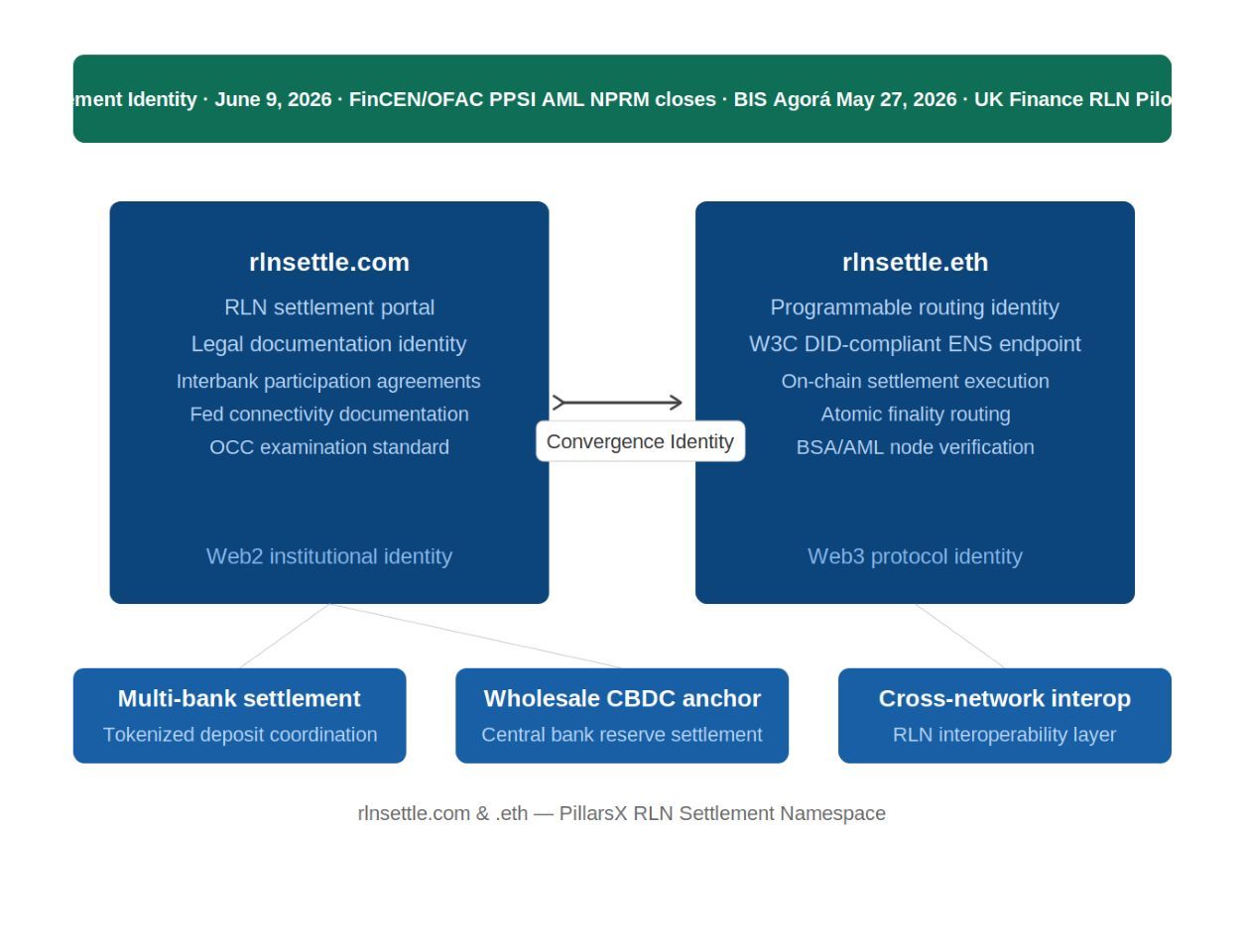
rlnsettle.com is the institutional Web2 portal identity for this documentation standard — the legal brand that appears in RLN participation agreements, Fed connectivity documentation, and interbank settlement contracts wherever RLN settlement must be referenced under banking law. <a href=”https://pillarsx.com/rlnledger/”>rlnledger.com & .eth</a> is the ledger infrastructure identity for the shared DLT platform that RLN settlement operates on. rlnsettle.eth is the programmable on-chain routing identity — the ENS endpoint that software architects embed directly into RLN settlement protocol logic to route tokenized liability transactions to atomic settlement without intermediary DNS dependency.
Together they form the complete Convergence Identity for the RLN settlement standard that every institution building multi-bank tokenized deposit infrastructure must establish.
Namespace Acquisition: This Twin-Domain asset is available for institutional acquisition. Inquiries: hq@pillarsx.com
The Regulatory Foundation of RLN Settlement
The Regulated Liability Network was first formally proposed in a 2022 whitepaper by a consortium of global banks including Citi, HSBC, BNY Mellon, and Mastercard — establishing the core principle that distributed ledger technology should be applied to regulated financial services without requiring a shift in the legal underpinnings of money. The Federal Reserve Bank of New York’s Innovation Center conducted a 12-week proof-of-concept in 2023 using hypothetical central bank and commercial bank USD liabilities, confirming that RLN is a viable and executable construct for regulated interbank settlement.
The Federal Reserve Board 2026 working paper confirmed that the RLN PoC working group employed tokenised central bank reserves as the settlement asset for all interbank settlement — establishing the central bank money anchor as the non-negotiable foundation of every RLN settlement transaction. This confirmation places RLN settlement directly within the GENIUS Act framework: the Act explicitly recognizes payment stablecoins as acceptable settlement assets to facilitate wholesale payments between banking organizations — and the RLN provides the regulated infrastructure through which this wholesale settlement occurs.
The GENIUS Act’s treatment of PPSIs as financial institutions for Bank Secrecy Act purposes means every RLN settlement transaction must satisfy FinCEN AML monitoring requirements at the moment of execution. The FinCEN/OFAC joint NPRM of April 2026 — with comment period closing June 9, 2026 — defines the precise BSA compliance obligations that apply to every settlement node in the RLN infrastructure. The RLN interoperability layer connecting settlement nodes across jurisdictions is documented at <a href=”https://pillarsx.com/rlninterop/”>rlninterop.com & .eth</a>.
The UK Finance live pilot running until mid-2026 demonstrates that RLN has moved beyond proof-of-concept into operational testing — with tokenised sterling deposits being tested across payment, remortgage, and digital asset settlement use cases simultaneously. The BIS Project Agorá findings of May 27, 2026 confirm that the RLN multi-bank architecture achieves the same atomic multi-currency settlement result across eight central bank jurisdictions that the Agorá prototype demonstrated. The deposit settlement layer that feeds into RLN infrastructure is documented at <a href=”https://pillarsx.com/depositsettle/”>depositsettle.com & .eth</a>.
How RLN Settlement Architecture Works
RLN settlement infrastructure operates through three simultaneous layers that rlnsettle.com documents and rlnsettle.eth routes through.
The tokenized liability layer converts existing regulated financial institution liabilities — commercial bank deposits, central bank reserves, regulated e-money, and GENIUS Act-compliant payment stablecoins — into DLT-native tokens that maintain their legal character as regulated liabilities throughout the settlement process. This layer preserves the two-tier monetary structure: commercial bank money for payments, central bank money for final settlement. The RLN ledger infrastructure underlying this tokenization layer is documented at <a href=”https://pillarsx.com/rlnledger/”>rlnledger.com & .eth</a>.
The atomic settlement layer executes simultaneous delivery-versus-payment across all participating institutions — achieving settlement finality at the moment of transaction execution without the sequential correspondent banking chains that create settlement risk in traditional infrastructure. The Federal Reserve Board working paper confirmed that settlement finality occurs at the moment all relevant entities approve the proposed payment — creating a legally definitive settlement record that satisfies OCC examination standards, FDIC BSA requirements, and FinCEN AML monitoring simultaneously.
The interoperability layer connects RLN settlement nodes across different DLT platforms, jurisdictions, and regulatory frameworks — enabling RLN participants to settle with institutions operating on different ledger infrastructures without abandoning the regulatory compliance requirements of their home jurisdiction. The GENIUS Act explicitly requires that payment stablecoin settlement infrastructure be acceptable as a settlement asset to facilitate wholesale payments between banking organizations — and the RLN interoperability layer is the mechanism through which this cross-institutional settlement occurs. Cross-network interoperability documentation is anchored at <a href=”https://pillarsx.com/rlninterop/”>rlninterop.com & .eth</a>.
rlnsettle.eth is the W3C DID-compliant ENS endpoint for this three-layer RLN settlement architecture — the on-chain routing identity that software architects embed directly into RLN settlement protocol logic to route tokenized liability transactions to atomic settlement across all participating institutions and jurisdictions.
The RLN Settlement Ecosystem
rlnsettle is the multi-bank settlement core of the PillarsX RLN namespace. It connects directly to <a href=”https://pillarsx.com/rlnledger/”>rlnledger.com & .eth</a> as the shared DLT ledger infrastructure on which RLN settlement executes, and to <a href=”https://pillarsx.com/rlninterop/”>rlninterop.com & .eth</a> as the cross-network interoperability identity that connects RLN settlement nodes across jurisdictions and platforms.
Beyond the RLN cluster, rlnsettle integrates with <a href=”https://pillarsx.com/depositsettle/”>depositsettle.com & .eth</a> as the commercial bank deposit settlement identity whose tokenized deposits flow across RLN rails, <a href=”https://pillarsx.com/wcbdcsettle/”>wcbdcsettle.com & .eth</a> as the wholesale CBDC settlement identity that provides the central bank money anchor for every RLN transaction, and <a href=”https://pillarsx.com/pontessettle/”>pontessettle.com & .eth</a> as the ECB Pontes bridge that connects European RLN settlement to TARGET Services from September 2026.
The complete RLN settlement stack — rlnsettle for legal documentation, rlnledger for DLT infrastructure, rlninterop for cross-network connectivity — provides every participating institution with a complete RLN settlement identity that covers operational execution, legal filing, and on-chain verification simultaneously. The multichain banking identity for the parallel bank-led approach to cross-network deposit token infrastructure — distinct from RLN’s shared multi-bank ledger model but addressing the same structural need for institutions operating across more than one blockchain — is documented at multichainbanking.com & .eth.
Related Infrastructure Series
STRATEGIC CONSTELLATIONS & BUNDLE POTENTIAL
Bundle 1 — “The RLN Core Series” (for Multi-Bank Settlement Participants) Target: JPMorgan, Citi, HSBC, BNY Mellon, Deutsche Bank — all original RLN PoC participants building interbank tokenized deposit infrastructure. Domains: rlnsettle.com/.eth + rlnledger.com/.eth + rlninterop.com/.eth. Complete RLN namespace — settlement identity, ledger infrastructure, and cross-network interoperability in one acquisition.
Bundle 2 — “The Tokenized Deposit Settlement Stack” (for BIS Agorá and ECB Pontes Participants) Target: Every institution participating in BIS Agorá real-value testing or ECB Pontes September 2026 launch. Domains: rlnsettle.com/.eth + depositsettle.com/.eth + pontessettle.com/.eth. Complete tokenized deposit settlement namespace — RLN multi-bank layer, commercial bank deposit identity, and ECB Pontes bridge.
Bundle 3 — “The Full Wholesale Settlement Infrastructure” (for Strategic Acquirers) Domains: rlnsettle.com/.eth + rlnledger.com/.eth + rlninterop.com/.eth + depositsettle.com/.eth + wcbdcsettle.com/.eth. The complete PillarsX wholesale settlement namespace — every layer from RLN multi-bank coordination through tokenized deposits to wholesale CBDC anchoring. This package exists exactly once.
📄 Academic Foundation
Twin-Domain Convergence Identity — The Institutional Framework Behind This Namespace
This Twin-Domain asset is part of the namespace architecture formalized in "Twin-Domain Convergence Identity: A Framework for Institutional Namespace Standards in Regulated Digital Asset Infrastructure" by Rolf Neumayr, PillarsX (SSRN Working Paper, 16 pages, posted June 12, 2026), classified under Monetary Economics — International Financial Flows, Financial Crises, Regulation & Supervision.
→ Read the Paper on SSRNRegulatory Sources
- Federal Reserve Board Working Paper — RLN as Regulated FMI Construct, 2026
- Federal Reserve Bank of New York — RLN Proof of Concept Findings, July 2023
- BIS Project Agorá Final Report — Multi-Bank Tokenized Deposit Settlement, May 27, 2026
- Federal Register — FinCEN/OFAC PPSI AML/Sanctions NPRM, April 10, 2026
- UK Finance — RLN Live Pilot Phase, Tokenised Sterling Deposits, December 2025
- Addleshaw Goddard — UK RLN Pilot Analysis, December 2025
Explore Related PillarsX Infrastructure
- rlnledger.com & .eth — RLN Ledger Infrastructure Identity
- rlninterop.com & .eth — RLN Interoperability Identity
- depositsettle.com & .eth — Deposit Settlement Identity
- wcbdcsettle.com & .eth — Wholesale CBDC Settlement Identity
- pontessettle.com & .eth — ECB Pontes Settlement Identity
- ppsisettle.com & .eth — PPSI Settlement Identity
- sovereignsettle.com & .eth — Sovereign Settlement Identity
- assetinterop.com & .eth — Asset Interoperability Identity
Strategic Acquisition Inquiry
Initiate secure communication with representatives of the IP holder to evaluate the acquisition of this premium infrastructure namespace or its corresponding strategic asset bundle.