
smartinterop.com & .eth | Smart Interop Identity
🔴 Regulatory Update — June 23, 2026
BIS Annual Economic Report 2026 defines smart contract interoperability as the structural standard for the next-generation monetary system — DTCC Collateral AppChain on Chainlink CRE targets Q4 2026 as BIS confirms fragmented smart contract environments trap liquidity and erode monetary singleness
The BIS Annual Economic Report 2026, Chapter III, published June 23, confirms that interoperability — the ability for smart contract logic, assets, and settlement instructions to flow seamlessly across DLT platforms — is the connective tissue of the next-generation monetary system. The BIS warns that both public permissionless chains and isolated private permissioned networks fail this standard: fragmented smart contract environments force costly intermediation, trap liquidity, and erode the singleness of money. The solution the BIS defines is interoperable permissioned networks with compliance embedded at the smart contract layer — precisely the architecture DTCC deployed in its Collateral AppChain on Chainlink's Runtime Environment, announced May 12, 2026, with a July 2026 live-transaction test and Q4 2026 production launch across 50+ institutions and $4.7 quadrillion in annual securities transactions. Deutsche Bank confirmed in April 2026 that smart contract standards and messaging protocols are the essential prerequisites for tokenized finance at institutional scale. smartinterop.com & .eth is the institutional namespace for smart contract interoperability identity — anchored to the BIS standard published today and the DTCC production deployment in Q4 2026.
→ Source: BIS Annual Economic Report 2026, Chapter III — Smart Contract Interoperability Standard, June 23, 2026🔴 Regulatory Update — June 23, 2026
DTCC Collateral AppChain on Chainlink CRE targets Q4 2026 production launch — smart contract interoperability becomes the shared infrastructure standard for $4.7 quadrillion in annual securities transactions as BIS confirms interoperability as the connective tissue of the next-generation monetary system
DTCC announced on May 12, 2026 that its Collateral AppChain — the shared infrastructure platform for 24/7 collateral movement across global markets — will integrate Chainlink's Runtime Environment and data standard as its smart contract interoperability layer. Chainlink CRE orchestrates pricing, valuation, margining, collateral optimization, and settlement workflows through reusable smart contract logic, enabling DTCC to scale across new asset classes and data types without rebuilding custom integrations. More than 50 institutions are in the working group, with a July 2026 live-transaction test and Q4 2026 production launch. Simultaneously, the BIS Annual Economic Report 2026, published June 23, confirmed that interoperability — the ability for smart contract logic, assets, and settlement instructions to move seamlessly across DLT platforms and traditional financial infrastructure — is the structural requirement of the next-generation monetary system: without it, network effects fragment and monetary singleness erodes. Deutsche Bank, ECB Pontes, and Circle have each independently confirmed that smart contract interoperability underpinned by common data models, messaging protocols, and compliance-embedded standards is the prerequisite for tokenized finance at institutional scale. smartinterop.com & .eth is the institutional namespace for this standard — registered before the Q4 2026 production launch defines the compliance baseline.
→ Source: DTCC — Collateral AppChain Chainlink CRE Integration, May 12, 2026; BIS Annual Economic Report 2026, Chapter III, June 23, 2026Smart interop is the infrastructure condition in which smart contract logic — the automated execution rules that govern tokenized asset transfers, collateral eligibility checks, margining calculations, and settlement instructions — operates seamlessly across different DLT platforms, traditional financial systems, and regulatory jurisdictions without requiring custom point-to-point integrations for each combination. It is not merely cross-chain messaging; it is the full stack of data access, compliance embedding, privacy preservation, and orchestration that allows a smart contract written once to execute reliably across the entire institutional financial infrastructure.
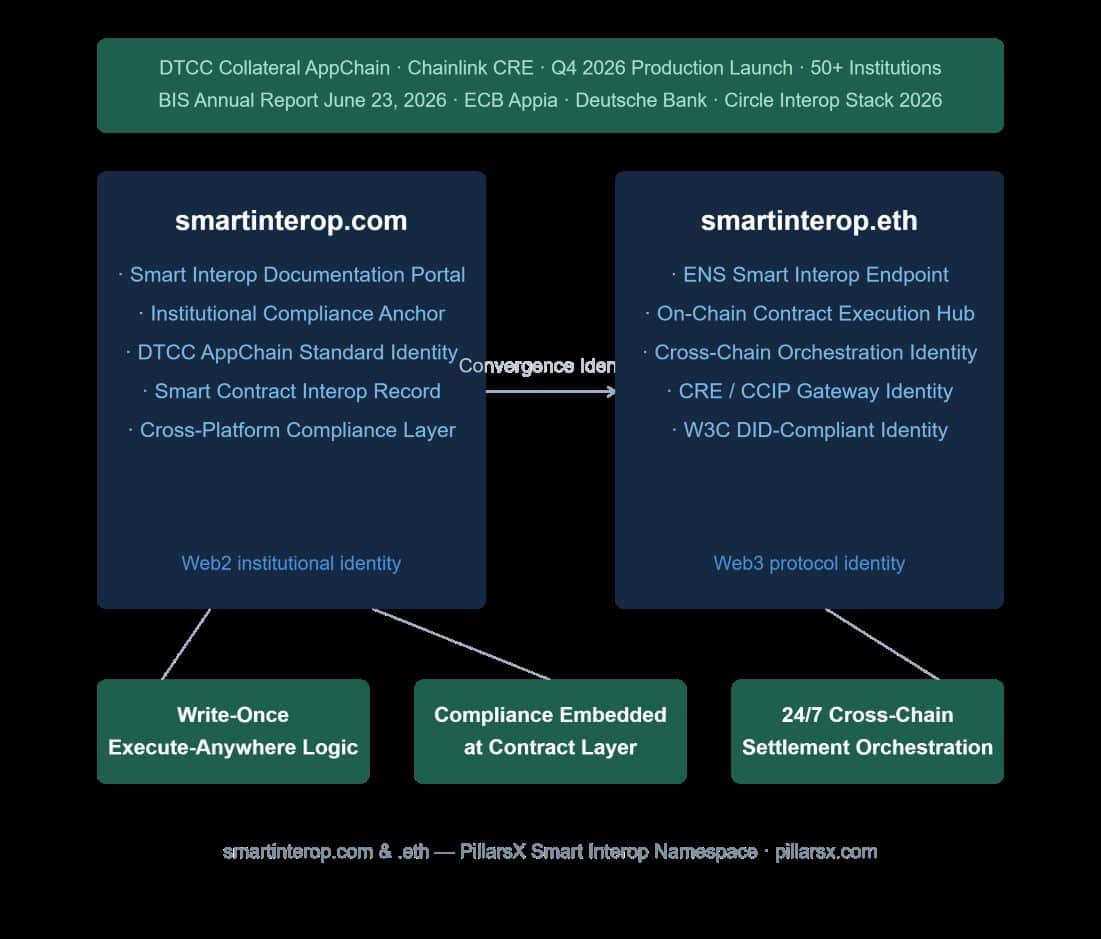
DTCC’s Chainlink CRE integration — targeting Q4 2026 production launch across $4.7 quadrillion in annual securities transactions — is the largest institutional deployment of smart interop infrastructure in history. The BIS Annual Economic Report 2026, published June 23, confirms smart contract interoperability as the connective tissue of the next-generation monetary system: without it, DLT networks fragment into walled gardens, liquidity traps accumulate, and the singleness of money erodes. smartinterop.com & .eth is the Convergence Identity for this infrastructure standard — the institutional namespace anchoring smart interop identity before the Q4 2026 production deployments define the compliance baseline.
Namespace Acquisition: This Twin-Domain asset is available for institutional acquisition. Inquiries: hq@pillarsx.com
Why Smart Contracts Require a Dedicated Interoperability Layer to Function at Institutional Scale
Early smart contracts were designed for single-chain, open environments — they executed reliably within one blockchain but had no mechanism to access data from external systems, comply with regulatory requirements embedded in traditional infrastructure, or coordinate execution across different ledger environments. This limitation was acceptable for DeFi protocols serving retail users on public chains. It is structurally incompatible with institutional finance, where a single collateral management workflow requires data from market pricing systems, custody records, regulatory eligibility lists, margin calculation engines, and settlement instructions that span multiple blockchains, legacy systems, and jurisdictional frameworks simultaneously.
Chainlink’s institutional smart contract architecture resolves this through three integrated layers: the Cross-Chain Interoperability Protocol enabling secure asset and message movement across blockchains; the Runtime Environment orchestrating workflows across both on-chain and off-chain systems; and the data standard providing verified market data, compliance checks, and eligibility determinations that smart contracts can trust without relying on unverified inputs. DTCC confirmed that CRE provides a reusable framework enabling the Collateral AppChain to scale across new data types and asset classes without rebuilding the data pipeline — the precise definition of smart interop: write-once, execute-anywhere contract logic with embedded compliance. The DLT interoperability identity for the cross-platform DLT connectivity layer within which smart interop logic executes is documented at dltinterop.com & .eth. The asset interoperability identity for the cross-platform asset transfer standard that smart interop orchestrates is documented at assetinterop.com & .eth.
BIS, ECB, Deutsche Bank, and Circle — Four Primary Sources Confirming Smart Interop as the 2026 Structural Requirement
The convergence of primary institutional sources on smart interop as a 2026 structural requirement is unprecedented. The BIS Annual Economic Report 2026 published June 23 defines interoperability as “money’s connective tissue” — the mechanism through which atomic settlement, singleness of money, and network effects compound rather than fragment. The ECB’s Appia roadmap, published March 2026, lists technical standards and interoperability as the first of six building blocks for the European tokenized financial ecosystem, with a 2028 delivery target. Deutsche Bank confirmed in April 2026 that interoperability underpinned by common data models, smart contract standards, and messaging protocols is the essential prerequisite for collateral mobility and settlement efficiency in tokenized finance. Circle published its 2026 vision for the “interoperability stack” in April, positioning smart contract-based cross-chain execution as the infrastructure equivalent of TCP/IP for the internet financial system.
Each of these institutions describes the same requirement from a different vantage point: the problem is not that smart contracts don’t work, but that they work in isolation. Smart interop is the solution — the shared standard that allows contract logic, asset data, and compliance rules to flow across the entire institutional stack. The RLN interoperability identity for the regulated liability network layer within which smart interop standards must operate across bank and non-bank participants is documented at rlninterop.com & .eth. The stablecoin interoperability identity for the cross-chain stablecoin transfer layer that smart interop orchestrates is documented at stablecoininterop.com & .eth.
The Smart Interop Ecosystem — Collateral, Settlement, FHE, and Cross-Chain Orchestration
smartinterop is the smart contract execution identity within the broader PillarsX interoperability and settlement namespace. It connects directly to dltinterop.com & .eth as the DLT-layer connectivity standard within which smart interop logic is deployed, and to assetinterop.com & .eth as the asset transfer standard that smart interop orchestrates across chains and legacy systems.
Beyond the immediate interoperability stack, smartinterop integrates with unifiedcollateral.com & .eth as the collateral mobility infrastructure that smart interop enables through automated eligibility, margining, and settlement workflows; fheinterop.com & .eth as the privacy-preserving interoperability layer for institutions requiring encrypted smart contract execution across platforms; syncsettle.com & .eth as the synchronized settlement identity for the atomic finality that smart interop-orchestrated transactions achieve; and stablecoininterop.com & .eth as the cross-chain stablecoin transfer layer where smart interop standards govern USDC, EURC, and tokenized deposit movement. Chainlink co-founder Sergey Nazarov confirmed on May 12, 2026 that DTCC’s Collateral AppChain represents the moment that brings “the full value of smart contracts to the traditional finance industry” — the production milestone that smartinterop.com & .eth was registered to anchor.
📄 Academic Foundation
Twin-Domain Convergence Identity — The Institutional Framework Behind This Namespace
This Twin-Domain asset is part of the namespace architecture formalized in "Twin-Domain Convergence Identity: A Framework for Institutional Namespace Standards in Regulated Digital Asset Infrastructure" by Rolf Neumayr, PillarsX (SSRN Working Paper, 16 pages, posted June 12, 2026), classified under Monetary Economics — International Financial Flows, Financial Crises, Regulation & Supervision.
→ Read the Paper on SSRNRelated Infrastructure Series
Strategic Constellations & Bundle Potential:
Bundle 1, “The Smart Interop Core”, für DLT-Plattformbetreiber und Smart-Contract-Infrastruktur-Provider. Target: Chainlink, DTCC, Euroclear, Swift. Domains: smartinterop.com/.eth + dltinterop.com/.eth + assetinterop.com/.eth. Complete smart interop namespace — smart contract execution identity, DLT connectivity layer, und asset transfer standard.
Bundle 2, “The Institutional Smart Contract Compliance Stack”, für regulierte Institutionen mit Multi-Chain-Deployment. Target: Deutsche Bank, JP Morgan, BNY Mellon, Goldman Sachs. Domains: smartinterop.com/.eth + fheinterop.com/.eth + stablecoininterop.com/.eth. Complete compliance-embedded interop namespace — smart interop execution, FHE-privacy layer, und stablecoin cross-chain standard.
Bundle 3, “The Full Interoperability Namespace”, für Strategic Acquirers. Domains: smartinterop.com/.eth + dltinterop.com/.eth + assetinterop.com/.eth + fheinterop.com/.eth + rlninterop.com/.eth + stablecoininterop.com/.eth + unifiedcollateral.com/.eth. The complete PillarsX interoperability namespace. This package exists exactly once.
Regulatory Sources
- DTCC — Collateral AppChain Chainlink CRE Integration, Q4 2026 Production Launch, May 12, 2026
- BIS Annual Economic Report 2026, Chapter III — Interoperability as Money's Connective Tissue, June 23, 2026
- Deutsche Bank — Smart Contract Standards and Messaging Protocols as Interoperability Prerequisite, April 2026
- ECB — Appia Roadmap: Technical Standards and Interoperability as Building Block 1, March 2026
- Circle — Interoperability Stack for the Internet Financial System, April 2026
- Chainlink — End-to-End Interoperability Standard for Institutional Tokenization, January 2026
Explore Related PillarsX Infrastructure
- dltinterop.com & .eth — DLT Interoperability Identity
- assetinterop.com & .eth — Asset Interoperability Identity
- fheinterop.com & .eth — FHE Interoperability Identity
- rlninterop.com & .eth — RLN Interoperability Identity
- stablecoininterop.com & .eth — Stablecoin Interop Identity
- unifiedcollateral.com & .eth — Unified Collateral Identity
Strategic Acquisition Inquiry
Initiate secure communication with representatives of the IP holder to evaluate the acquisition of this premium infrastructure namespace or its corresponding strategic asset bundle.