
solverintent.com & .eth | Solver Intent Identity
🔴 Regulatory Update — June 10, 2026
Mastercard Agent Pay for Machines operationalizes solver intent at institutional scale — AI agents declare outcomes, solvers execute with enforced compliance rules and guaranteed settlement
Mastercard launched Agent Pay for Machines on June 10, 2026 — the first institutional-scale deployment of the solver intent model: AI agents declare what payment outcome they need, and a competitive execution layer delivers it with enforced controls, smart contracts, and guaranteed settlement. Ripple confirmed XRPL and RLUSD provide the settlement rails with full audit trails. This is the solver intent architecture operationalized at machine speed by the world's largest payment network — confirming that every institutional AI agent payment system requires a documented solver intent identity that satisfies GENIUS Act BSA requirements and CLARITY Act market structure rules simultaneously.
→ Source: Mastercard — Agent Pay for Machines, June 10, 2026In 2026, the intent-solver architecture has become the dominant execution model for institutional DeFi and AI agent payments. Instead of signing a transaction that dictates how a chain should move state, an institution or AI agent signs an intent that declares what outcome is needed — and a competitive network of professional solvers races to deliver it with guaranteed execution quality, MEV protection, and cross-chain routing.
Mastercard confirmed this architecture at institutional scale on June 10, 2026 with the launch of Agent Pay for Machines: AI agents declare payment outcomes, Ripple/XRPL delivers compliant execution with full audit trails. The SEC Chairman Atkins confirmed on May 9, 2026 that near-instantaneous solver-based settlement is reshaping the SEC’s entire onchain markets regulatory framework. The CLARITY Act — at 75% passage probability with a floor vote imminent — establishes compliance requirements for digital asset execution platforms that operate the solver layer.
The institutional problem is precise: solver networks deliver superior execution quality, MEV protection, and cross-chain efficiency — but every institutional solver executing GENIUS Act PPSI redemptions, tokenized RWA transfers, or AI agent payments must document its intent verification standard in a format that satisfies OCC examination standards, FinCEN AML monitoring, and CLARITY Act market structure rules simultaneously.
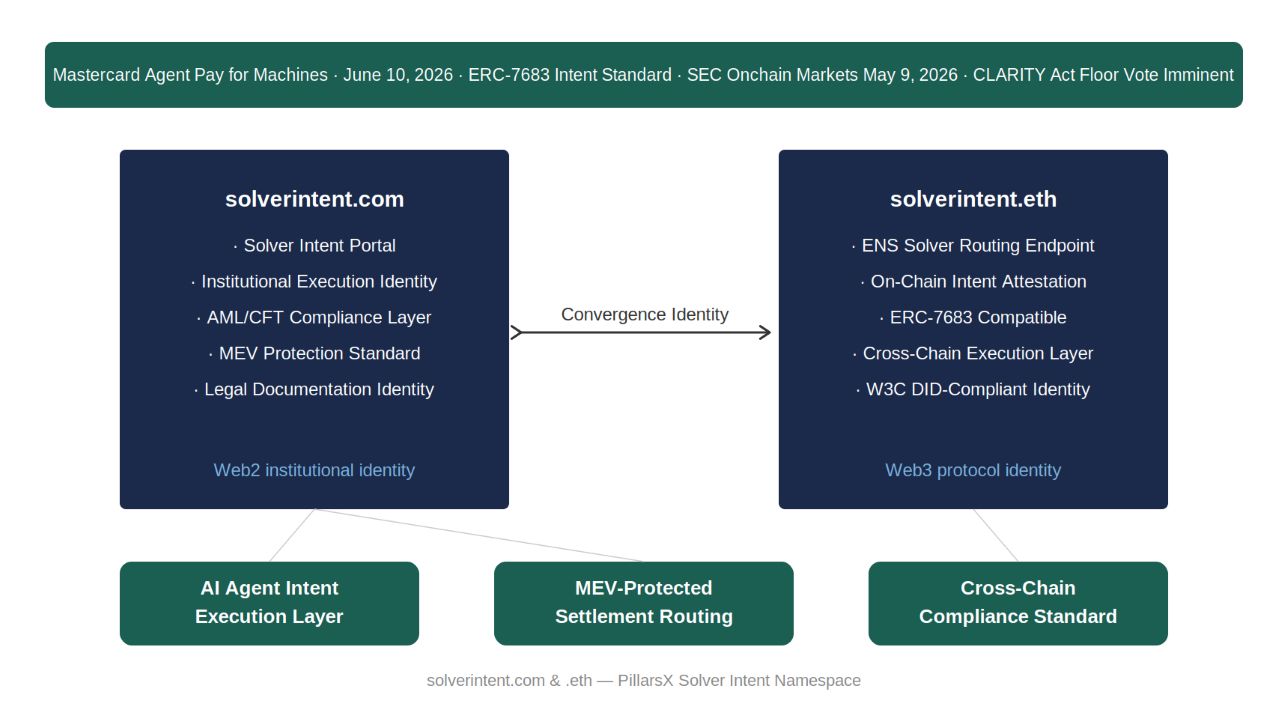
solverintent.com is the institutional Web2 portal identity for this compliance standard — the legal brand that appears in GENIUS Act compliance documentation, CLARITY Act exchange registration filings, and institutional solver participation agreements wherever solver intent must be referenced under banking law and market structure regulation. solverintent.eth is the programmable on-chain routing identity — the ERC-7683 compatible ENS endpoint that software architects embed directly into cross-chain solver intent protocol logic to route institutional execution to atomic settlement without intermediary DNS dependency.
Together they form the complete Convergence Identity for the institutional solver intent standard that every compliant AI agent payment platform, tokenized asset execution venue, and PPSI redemption solver must establish.
Namespace Acquisition: This Twin-Domain asset is available for institutional acquisition. Inquiries: hq@pillarsx.com
Why Institutional Solver Intent Requires a Compliance Namespace in 2026
The solver intent model has reached institutional maturity in 2026. CoW Swap, UniswapX, Anoma, SUAVE, and Across now run battle-tested solver auctions with hundreds of professional solvers competing in real time — delivering near-perfect fill rates with built-in MEV protection. AI-powered solvers can optimize yield strategies, auto-rebalance portfolios, and execute private deals autonomously. The ERC-7683 standard has established a common cross-chain intent format enabling solvers to operate across Ethereum, Base, Arbitrum, and other networks without fragmentation.
The compliance gap is precise: every institutional solver executing PPSI redemptions under the GENIUS Act must satisfy FinCEN AML monitoring requirements at the moment of execution — not post-trade. The FinCEN/OFAC PPSI AML NPRM confirmed this with a comment deadline of June 9, 2026: solver-mediated stablecoin transfers are subject to BSA transaction monitoring as financial institution payments. The CLARITY Act simultaneously establishes registration requirements for digital asset execution platforms — every solver network operating as a digital commodity exchange or broker must document its intent verification framework under the new market structure rules. The stablecoin intent verification standard for PPSI redemptions executed through solvers is documented at stablecoinintent.com & .eth.
The SEC Chairman Atkins confirmed on May 9, 2026 that solver-based near-instantaneous settlement is reshaping the clearing agency definition for onchain markets. When solvers deliver execution with guaranteed settlement finality, the traditional T+2 clearing model becomes structurally obsolete — and every solver must document its settlement finality standard in a format that satisfies SEC examination requirements. The instant DVP settlement identity for solver-executed transactions is documented at instantdvp.com & .eth.
How Institutional Solver Intent Architecture Resolves the Compliance-Execution Tradeoff
The institutional solver intent architecture operates through three simultaneous layers that solverintent.com documents and solverintent.eth routes through.
The intent declaration layer captures the institution’s or AI agent’s desired outcome — specifying what asset transfer, redemption, or payment must occur, under what compliance constraints, and with what settlement finality requirements. Unlike traditional transactions that specify execution path, intents specify outcomes — enabling solvers to find the optimal execution path while the institution maintains full compliance control over the declared parameters. The verifiable intent standard governing outcome declarations across all institutional asset classes is documented at verifiableintent.com & .eth.
The solver execution layer routes the intent to the optimal execution path — batching multiple intents, routing through gas-optimized cross-chain paths, and protecting against MEV extraction simultaneously. MEV protection is the most immediate compliance benefit: because the institution never broadcasts a transaction with exact execution parameters, there is no public mempool exposure for front-running. Solvers bear MEV risk and price it into their quote — and competition keeps execution spreads tight while maintaining AML compliance at every routing node. The AML intent verification confirming every solver-mediated transaction against BSA monitoring requirements is documented at amlintent.com & .eth.
The settlement finality layer delivers atomic execution with cryptographically verifiable finality — the solver submits the fill and both counterparties receive simultaneous confirmation that settlement is complete, irrevocable, and compliant. Cross-chain solver settlements can take place across two separate chains with the asset and cash legs operating independently while settling atomically without counterparty risk. The programmable compliance enforcement layer ensuring solver execution satisfies AML/CFT rules on-chain is documented at programmablecompliance.com & .eth.
The Solver Intent Ecosystem — From AI Agent Payments to Tokenized RWA Execution
solverintent is the institutional execution identity at the convergence of AI agent payments, tokenized asset settlement, and compliant DeFi infrastructure. It connects directly to verifiableintent.com & .eth as the generalized intent verification framework of which solver intent is the execution-layer implementation, and to stablecoinintent.com & .eth as the PPSI-specific intent verification standard for stablecoin redemptions executed through solver networks.
Beyond the intent cluster, solverintent integrates with instantdvp.com & .eth as the instant DVP settlement identity for solver-executed atomic asset transfers, programmablecompliance.com & .eth as the automated compliance ruleset enforcing GENIUS Act and CLARITY Act requirements at every solver execution node, and amlintent.com & .eth as the AML intent verification standard governing the compliance layer of every solver-mediated stablecoin transaction. The RWA solver execution infrastructure connecting tokenized real-world assets to compliant solver networks is documented at rwasolver.com & .eth.
The complete solver intent stack — solverintent for institutional documentation, verifiableintent for generalized framework, stablecoinintent for PPSI compliance — provides every AI agent payment platform, tokenized asset execution venue, and institutional DeFi protocol with a complete intent namespace covering legal documentation, on-chain routing, and regulatory examination simultaneously.
Related Infrastructure Series
STRATEGIC CONSTELLATIONS & BUNDLE POTENTIAL
Bundle 1 — “The Institutional Intent Execution Core” (for AI Agent Payment Platforms) Target: Mastercard Agent Pay partners, Ripple/XRPL ecosystem, OpenAI/Anthropic payment agent platforms — all deploying AI agents that require compliant solver intent execution. Domains: solverintent.com/.eth + verifiableintent.com/.eth + stablecoinintent.com/.eth. Complete institutional intent namespace — solver execution identity, generalized intent framework, and stablecoin compliance layer.
Bundle 2 — “The Compliant DeFi Execution Stack” (for Institutional DeFi Infrastructure) Target: CoW Protocol, UniswapX, Across, Anoma — solver networks seeking institutional compliance certification under GENIUS Act and CLARITY Act frameworks. Domains: solverintent.com/.eth + amlintent.com/.eth + programmablecompliance.com/.eth. Complete compliant execution namespace — solver intent identity, AML compliance layer, and programmable enforcement standard.
Bundle 3 — “The Full Intent and Execution Namespace” (for Strategic Acquirers) Domains: solverintent.com/.eth + verifiableintent.com/.eth + stablecoinintent.com/.eth + amlintent.com/.eth + instantdvp.com/.eth. The complete PillarsX intent and execution namespace — every layer from solver intent declaration through stablecoin compliance to instant DVP finality. This package exists exactly once.
Regulatory Sources
- Mastercard — Agent Pay for Machines, Solver Intent at Institutional Scale, June 10, 2026
- SEC Chairman Atkins — Onchain Financial Markets and Solver Settlement, May 9, 2026
- Federal Register — FinCEN/OFAC PPSI AML NPRM, Solver-Mediated Stablecoin Transfers, April 10, 2026
- CLARITY Act H.R. 3633 — Digital Asset Execution Platform Registration, Senate Calendar June 1, 2026
- ERC-7683 — Cross-Chain Intent Standard, 2025
- DeFiLlama — State of DeFi 2025, Solver-Mediated Execution, March 2026
Explore Related PillarsX Infrastructure
- verifiableintent.com & .eth — Verifiable Intent Identity
- stablecoinintent.com & .eth — Stablecoin Intent Verification Identity
- amlintent.com & .eth — AML Intent Verification Identity
- intentverify.com & .eth — Intent Verification Identity
- instantdvp.com & .eth — Instant DVP Settlement Identity
- programmablecompliance.com & .eth — Programmable Compliance Identity
- rwasolver.com & .eth — RWA Solver Identity
- dltsettle.com & .eth — DLT Settlement Namespace
Strategic Acquisition Inquiry
Initiate secure communication with representatives of the IP holder to evaluate the acquisition of this premium infrastructure namespace or its corresponding strategic asset bundle.